|
E-Newsletter • November 2026 |
▼ ADVERTISEMENT
  |
Editor's E-Note
Thanksgiving is almost here, which means family celebrations, football, and RSNA. To help you get your preshow bearings after the holiday or if you’re just curious about what’s new this year, we have an RSNA preview in this month’s newsletter.
This year’s theme is “At the Center of Care” and RSNA president Jeffrey S. Klein, MD, will kick off the plenary sessions on Sunday afternoon, November 29, with his President’s Address. As usual, there will be many interesting plenary, educational, and science sessions to grab your attention, as well as plenty of activity in the exhibit hall, not to mention the many excellent dining establishments in Chicago.
From all of us at Radiology Today, Happy Thanksgiving! And if you happen to be at RSNA, please visit us at booth #3161 in the South Hall.
For more of the latest imaging news, visit us on X, formerly known as Twitter, and/or Facebook.
Enjoy the newsletter.
— Dave Yeager, editor |
|
|
| In This E-Newsletter
|
▼ ADVERTISEMENT
 |
|
|
RSNA 2026 Preview
The RSNA conference kicks off on Sunday, November 29. This year’s theme is “At the Center of Care.” For the President’s Address, Jeffrey S. Klein, MD, will discuss the role radiology plays in detecting, managing, and treating disease, while looking ahead to the specialty’s position in modern health care. Following Klein’s address, Jonathan S. Lewin, MD, will present “Seeing Beyond the Image: Leadership Lessons From the Reading Room to the Boardroom.” Lewin will highlight leadership lessons inspired by radiologic practice and explore how radiology can help lead health care through the challenges of digital governance, integrated care redesign, and AI-augmented workforce models, while advocating for the value of the imaging enterprise.
On Monday, November 30, Gwendolyn M. Bryant-Smith, MD, will present “Breast Radiology at the Center of Care: Advancing Patient-Centered Innovation, Collaboration, and Community Impact.” Bryant-Smith will talk about how breast radiologists can take the lead in delivering innovative care models, by integrating multidisciplinary collaboration with community-focused strategies. She will also discuss how taking on more patient-facing and collaborative roles can improve population health and reduce burnout among radiologists.
There will also be an image interpretation session on November 30. Five experts will be shown unknown cases and offer insight into how they analyze images and develop a differential diagnosis. Amy K. Patel, MD, is the moderator, and the experts are Niketa Chotai, MD, DNB, FRCR (breast imaging); Laura L. Avery, MD (emergency radiology); Benjamin E. Northrup, MD (musculoskeletal imaging); Gennaro D’Anna, MD (neuroradiology); and Jesse L. Courtier, MD (pediatric imaging).
|
Ultrasound-Guided Procedure Relieves Carpal Tunnel Symptoms
A minimally invasive, ultrasound-guided procedure demonstrated better long-term results than corticosteroid injections in a controlled randomized trial for relieving symptoms of carpal tunnel syndrome. The procedure, nerve hydrodissection, involves injecting fluid under ultrasound guidance around the affected nerve to release it from surrounding adhesions.
AI Helps Fill Gaps in Brain Wiring Maps
Researchers have developed an AI model that helps fill gaps in brain wiring maps made with diffusion MRI. The model targets the brainstem and the orbitofrontal region above the eyes, two areas that are prone to imaging distortions from a scanner’s magnetic fields.
Ultrasound-Based Cancer Treatment Center Opens
The University of Michigan Histotripsy Center, a first-of-its-kind cancer treatment center, opened recently. Histotripsy is an ultrasound-based approach to treating tumors that allows them to be destroyed without surgery and with few side effects.
Cyclotron Expansion Bolsters Theranostics Hub
A $62 million cyclotron expansion project at the University of Wisconsin School of Medicine and Public Health in Madison is expected to boost theranostics research and practice. By creating more and more varied radioisotopes, researchers hope to advance the scope of precision medicine.
|
“Children and adolescents are not simply small adults. Using adult risk assessment tools in young patients may create unnecessary concern and lead to procedures that do not improve care.”
— Stamatia Destounis, MD, FACR, chair of the ACR Commission on Breast Imaging, noting that BI-RADS criteria were developed for adults and can overestimate the risk of cancer in pediatric patients, potentially leading to unnecessary biopsies or procedures
▼ ADVERTISEMENT
 |
|
|
|
COVER STORY
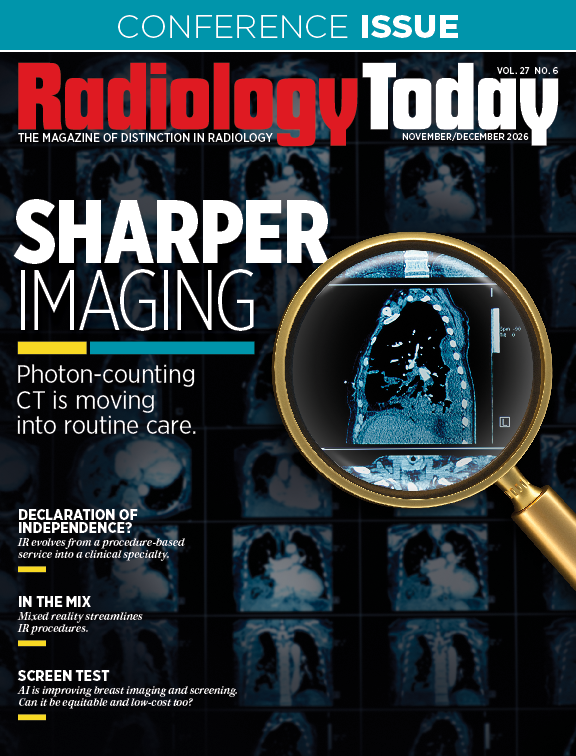
Sharper Imaging
Photon-counting CT is moving into routine care, but more research is ongoing to determine the best use cases for it.
FEATURE
Declaration of Independence?
As IR has increasingly become more of a clinical specialty, interventional radiologists are considering whether it’s time to separate from diagnostic radiology.
|
|
▼ ADVERTISEMENT
 |
|
| Advertising Opportunities |
Have a product or service you want to market to radiology professionals? Utilize the reach of Radiology Today Magazine to accomplish your marketing goals. Email our experienced account executives today at sales@gvpub.com or call 800-278-4400 for more information.
|
| © 2026 Radiology Today Magazine |
|
|